Showing posts with label Fairness. Show all posts

Monday, August 13, 2018

Rotten Trade

Let American Produce Rot
One would have to be living pretty deeply under a rock to not know that Canada is being bullied by president #45 of the United States of America. President Trump has unilaterally declared economic war on Canada, and entered into bilateral discussions with Mexico in an attempt to subvert the North American Free Trade Agreement (NAFTA). That is, of course, his prerogative. It would seem that Free Trade, as a concept, is completely foreign to Mr. Trump, because he only views a "negotiation" to be a success if he "wins" and the other guy "loses". Free Trade, on the other hand is all about mutual benefit, not winners and losers. As such, I don't expect that NAFTA will have a life until the orange man is out of the white house. While the government of Canada continues to press for mutual respect in negotiations with Washington, we are restricting our tariff activities to "tit-for-tat" adjustments. This is the civilized approach, and our government is wise to do so. However, when dealing with a bullying ape guerilla tactics are in order. It is time for all Canadians to stand on guard for Canada and hit the United States of America where it will hurt most, the pocket book.

I sent a letter today to Prime Minister Trudeau requesting that the product labelling laws in Canada be adjusted to require the provenance of products be displayed, by percentage from each country, on all packaging. For example, if a box of cereal is imported from Mexico but uses wheat from the USA, I may want to consider another brand that uses wheat from Canada. Or in another case, just because a pair of shoes is assembled in Canada doesn't mean that they don't use uppers and soles from the USA. Perhaps the government could certify products that have more than a certain percentage of Canadian content (say 80% or higher).

Such changes however, if chosen, would take a long time to implement. We Canadians must act now. So I am asking that all Canadians contact the grocery chains at the corporate level, and advise them that we will NOT be buying produce from the USA, and request that they identify other sources of produce for their stores.
Grocery Landscape in Canada
Grocery Landscape in Canada (click image to enlarge)
Almost all grocery stores in Canada are owned by one of three companies: either Empire Company Limited, Loblaw Companies Limited, or Metro. Writing to Loblaw Companies Limited one reaches 27 grocery and pharmacy chains. Writing to the Empire Company Limited, will reach 13 grocery chains. Writing to Metro will reach 5 grocery chains in Ontario and Quebec. To the best of my knowledge, there is nothing that is grown in the United States that cannot be either sourced from another country, or replaced with a comparable product from Canada. If the large grocery chains are made to understand that produce from the USA will just rot on their shelves, they will make other purchasing decisions, or they will lose sales to competitors who do.

The time to act is now. Stand up to this bully, and show him what Canadian grit and determination looks like. Call or write today. Don't know what to say? I've drafted some thoughts at the bottom of this page to get you started.

Loblaw Companies Limited

Customer Relations
Hours of Operation
Monday to Friday 8:30 am to 4:30 pm ET
Call toll-free: 1-888-495-5111
Email: customerservice@loblaws.ca

Empire Company Limited

Contact the Board of Directors
You may communicate with the Board of Directors through the Office of the Senior Vice President, General Counsel and Secretary in the following manner:
Doug Nathanson
Senior Vice President, General Counsel and Secretary
Empire Company Limited
115 King Street
Stellarton, Nova Scotia
B0K 1S0
E-mail: board@empireco.ca
Sobeys Customer Care
Atlantic
Call toll-free 1-888-944-0442
Monday to Friday 8:00 am to 5:00 pm (AST)
E-mail: customer.service@sobeys.com
Ontario
Call toll-free 1-888-821-5557
Monday to Friday 8:00 am to 4:30 pm (EST)
E-mail: customer.care.ontario@sobeys.com
West
Call toll-free 1-800-723-3929
Monday to Friday 8:00 am to 5:00 pm (MST)
E-mail: customer.helpline@sobeys.com

Metro

Call toll-free: 7-877-763-7374
or Fill out the web-form here.

Draft Email

Dear Sir or Madam,

I am a loyal customer of [name of chain].

I am very concerned about the situation involving Canada's trade with the United States. As such, I would like to advise you that, until an equitable NAFTA has been renegotiated that is fair to all trading partners, I will not be buying any produce that originates in the USA. I ask that you make sure that you source produce from other countries so that I continue to have the selection to which I am accustomed. If I cannot avoid American produce at your stores, I may have to avoid your stores to find stores that are willing to stand up for Canada.

Thank you in advance.

Sunday, November 13, 2016

Democrazy

Maybe it's time we re-think this whole "Democracy" thing. I am not proposing Communism (though in its pure form would be better than Democracy), and I am not proposing Anarchy (which in its pure form is better than Communism). However, it seems obvious to me after watching the turmoil surrounding the Arab Spring, the Brexit vote, the Trump victory, and numerous Canadian elections, that "Democracy", as it is currently implemented, is broken. It is time to move away from party politics and embrace direct representation.

I think it is time for "Democracy 2.0".

Before I go further, let me stress two things:
I am a layman. I have no political training whatsoever.
I don’t want to lead you. I have no political aspirations whatsoever.
What I do have is a desire to see mankind live in peace, and to see governments actually represent their people.

If you continue to do what you’ve always done, 
you will continue to see what you’ve always seen.

What’s wrong with the status-quo? When I reflect on the lack of direct representation in democracy, there is one thing that repeatedly jumps out at me: The Party Political Model. Under the party model, one person is appointed leader (or assumes leadership) of the party. This leader establishes the platform that the party rallies behind. The party then goes out into the country (or province), and places a candidate in each electoral district (or riding) that they can afford to. On Election Day, you (the people) then choose the party (and its leader) whose platform closest relates to your personal set of priorities. In Canada, this usually boils down to a decision between Liver & Onions or Onions & Liver. The local politician has very little say as to what issues are important, and is often bullied into voting the party line, especially on issues of significance. Your voice is heard only once every four years.
Based on photo by Arthur Chapman CC BY-NC-SA 2.0
In English, when one wants to say that something is out of order, one often says that “the cart is before the horse.” This is the current state of Democracy. As long as the leader of government is chosen before the members of government, the members will represent the leader before their constituents. This may have been needed at a time when most people had no way of knowing what a particular candidate’s opinion on the issues was. So, the party was trusted to assemble like-minded representatives. However, with the advent of the internet, and even more so Social Media, a constituent can know everything there is to know about a candidate. Fancy a life in politics? You had better keep your digital footprint clean.

Democracy 2.0 in Action

What would Democracy 2.0 look like? For starters, the size of the constituency would be based on the number of people an average representative can actually represent. I don’t know what that number is, that would require further research. But think of it this way, if a representative were to speak with a different constituent every half hour, seven hours a day, every week day for fifty weeks of the year, s/he could hear the opinions of 3,500 constituents. If the size of the constituency is 100,000 people, the opinions of those 3,500 constituents would reflect the entire population of the constituency 95% of the time with a 1.63 margin of error. (As an aside, the average population of Canadian federal ridings is 99,034.)

In Canada, we have a situation that doesn’t occur everywhere, but must be addressed in all countries where it does occur. Since the formation of Canada was the result of colonialization, we have an indigenous population. Our indigenous population is known as the “First Nations.” Due to the sleight of hand and wordsmithing skills of the colonial forces (not to mention military might), the First Nations are not represented equally in government. Under Democracy 2.0, each Nation of the First Nations would have a seat in government. We cannot undo the past, but we can fix the future.

So, now that we’ve nailed down the size of the constituency, let’s discuss candidates. All candidates that wish to represent a constituency must actually be from that constituency. Under the party model, it is not un-common for a party to move a candidate to a constituency where they cannot, or will not, field someone local. That person knows nothing about life in that area, and cannot possibly have a vested interest in the wellbeing of that community. If we remove the parties, we open the door to direct representation. The electorate focuses their decision making on choosing the candidate that best represents their beliefs and concerns.

You might ask: what about Leadership, and Opposition? How would that work? I would reply: ask yourself this: what do you expect the Opposition to do? Oppose. But what should they do when the law being debated has merit? Do you really want someone to sit in opposition to something they know to be right? Under Democracy 2.0, all members of the House of Representatives are members of the Government, and all members of the House of Representatives are members of the Opposition. Under Democracy 2.0, they are all expected to consider each bill or act (or whatever you call them in your context) under its own merit. Each representative can propose a bill for consideration by his or her peers, but there is no one person who is sitting in a position of authority over them. As such, there is no one person who influences their vote.

The role of Leader would be occupied by a member of the House of Representatives chosen by his or her peers. For this, I like the British term “Prime Minister.” This would be the first among equals, the Head of State. One must note however, that this position is external facing. As each representative is accountable to his or her constituency, this Prime Minister would be accountable to the House of Representatives, and would be expected to represent their beliefs and concerns on the world stage.

A Brave New World

The beauty of the Democracy 2.0 model is that it would scale really well. The same model could be applied to local governments, provincial (or state) governments, even to multilateral organizations like the United Nations. The challenge is making it a reality. The political machines that drive democratic implementations around the world are protectionist in nature, and are not likely to change from the inside. It would take a true statesman or stateswoman to give up power once granted the majority required to make Democracy 2.0 happen. But I can always dream.

Wednesday, May 11, 2016

The Culture of Poverty

From "The Devil's Miner"
I watched a report by Mathias Meier in the New York Times entitled "Embracing Child Labor". Bolivia, my birthplace, has made it legal for children to begin working at ten years of age.  I must say I am shocked and saddened. I am shocked that this has barely received any press in the developed world, and I am saddened to think of what this will mean for the future of these beautiful people.

I understand the logic of the proponents of child labour. The families are starving, the children are working already, let's make sure that they at least get a fair wage. In fairness, child labour happens to some degree all over the world. Even in North America, on family farms children are expected to perform duties before and after school that are critical to keeping the farm running. The same is true in many family run businesses in Bolivia, but this is not what we are talking about here. Here we are talking about children working at hard labour (mining, brick making, etc), and though it is not supposed to interfere with schooling, one would have to be quite naive to think that it doesn't.

In the above story, Dr. Jorge Domic, the director of Fundación La Paz (a development NGO), says that child labour is part of the Andean culture, and especially Bolivian culture. I beg to differ. Culture is not what a people do, it is who a people are. Culture is the characteristics of a people that distinguishes them from their neighbours. Being hard working and industrious can be seen as cultural. Keeping a segment of one's population poor due to lack of education is not cultural. Despite the promise of a socialist revolution, it is the rich in Bolivia that are profiting from this move, not the poor. Oh sure, the poor will get a few extra pennies, and that will make a difference, but it will be just enough to keep them poor. And by legalizing child labour, families who would have otherwise obeyed the law and endured the hardship of poverty, might be tempted by the newly legalized source of income.

According to the CIA World Factbook, 45% of Bolivians live on less that $2 per day. The Factbook also points out that:
"Bolivia's income inequality is the highest in Latin America and one of the highest in the world. Public education is of poor quality, and educational opportunities are among the most unevenly distributed in Latin America, with girls and indigenous and rural children less likely to be literate or to complete primary school."
So there's your problem. A third of the population is under the age of 15, you have a low quality system of public education, and the access to public education is not universal. Now you are going to compound the problem by making it OK for children to work for pay starting at ten years of age (and their "union" is pushing for that age to be lower still). I like how Alex Rosen put it in his article on this topic in "No Se Mancha":
"If this is Bolivia’s best answer, then perhaps they have asked the wrong question."
What is needed is a break in the cycle of generational poverty. This can only be accomplished by a high quality, universal, public education system. President Morales has done his people a huge disservice.

Sunday, March 29, 2015

Let's Play Damage Control

Credit: US Navy (CC-by-2.0)
Have you ever tried to put toothpaste back in the tube? Maybe shaving cream back into the can? How about words back into your mouth? The first one is hard; the second one, much harder; the third... impossible.

I was reading a story today about a father of a young girl with #CerebralPalsy. Dad would regularly bring his daughter to a particular indoor play establishment in Guelph, Ontario. Though the establishment had a policy of socks only, an exception has always been made for this little girl because she needed to wear her shoes and braces in order to climb on the play structures. I don't want to mention names (against my instinct as a father of a special needs child), because I am trying to make a general point, not point out a single incident. Having said that, if you are on Facebook and live in or near Guelph, Ontario; you probably know to which incident I am referring. As it turned out, at this particular visit, the owner of the establishment was present, and enforced her rules much more stringently than any of her employees have in the past. The father and daughter were shown the door, and forced to drive to a neighbouring town to complete the play date. As a result of the angry posts of this girl's parents, the establishment in question was so overrun with negative feedback that they decided to shut down their Facebook page. Unfortunately for this company, all that they accomplished with that action is to remove themselves from the conversation. 

So, what went wrong? Well, as with most similar incidents, this is the result of a comedy of errors.
1) Employees should have brought the exception to the attention of management.
I understand that this would have been a tough thing to expect of an employee. "Uhm, boss, yesterday I broke the rules, and I thought you should know about it." But maybe, the first visit would have been the place to cut this off at the pass. If the owner had a reputation as being an ethical entrepreneur, her employees might have been willing to ask the father for his contact information and say "I'm sorry, but right now I have to enforce the rules. I will discuss this situation with my boss and have her call you to discuss what options are possible in the future." While the father and daughter would have still been upset, they would have had the comfort of knowing that it was not impossible, just not possible now.
2) The owner and the father should have looked for alternatives that would address all concerns.
Now I don't know what would have been a possible alternative, I know very little about Cerebral Palsy, but a dialog with two experts (the owner as an expert in play structures, and the father as an expert in Cerebral Palsy), must have been able to come up with alternatives. Would it be safe for the little girl to where dad's socks over top of her shoes and braces? If not dad's socks, perhaps some other rubberized covering.
3) The organization should have stayed in the conversation.
Here is the attempt at damage control that the owner put out on Facebook just before the page went down:
The parents have since argued (adequately in my opinion) the first two points.
It was bad enough that the owner didn't stay in the conversation directly with the parents. Had she done that, and conveyed a sense of empathy and a desire to find a solution, the parents would probably not have launched their campaign to boycott the establishment. The entire thing would have been resolved without threatening the bottom line. 
In fact, the parents would probably have bragged about the care that the establishment had given them and the owner may have been sitting on a nice Ethical Credit. Instead, buy "pleading the fifth" and shutting down the Facebook page, the owner is now burdened with Ethical Debt, from under which she may never escape.
In The Art of the Start 2.0, @Guy Kawasaki points out how lawyers should be used. Rather than asking a layer if you should do something, Kawasaki says that you should say "This is what I want to do. Now, keep me out of jail." In my opinion, if you need a lawyer's advice on how to handle an irate customer, you've let it go too far.

Monday, March 23, 2015

What Makes a Great Leader?

Credit: Scott Maxwell
I read a discussion today from McKinsey & Company entitled Decoding leadership: What really matters. The authors discuss a study they conducted to try to identify "what sort of leadership behavior organizations should encourage". It seems that the researchers really conducted an exhaustive study. I congratulate them on their work.

A survey 189,000 people in 81 medium to large organizations, identified 4 key leadership behaviours that the strongest leaders possess. While that is interesting, what I find alarming is that the list of "20 possible types of behavior" that they used does not include  any mention of Ethics or Integrity. In fairness, some of the behaviours might be seen as ethical traits, but they aren't traits that would prevent Ethical Debt.
Where is the mention of Honesty, Fairness, Trustworthiness, Beyond Reproach, etc. Sure number 9 is "Foster mutual respect", and while that is important, it doesn't scream out "Always do the right thing".

My grandfather used to be an accountant. I remember a story that I heard about him that went something like this:
Someone approached one of his clients and asked for an introduction to my grandfather as they were looking for someone to fix their books so that they wouldn't have to pay so much tax. Apparently, my grandfather's client told him "Don't bother asking Mr. Rochow, he would never do that kind of book-keeping."
That is the kind of ethics that all leaders should possess and cultivate in their organizations. You want a reputation that is so ethical that nobody would ever even consider asking you to do something that is not above board. That is the way to avoid Ethical Debt.

Saturday, March 7, 2015

What is Ethical Debt?

As ethics are the moral compass of a society, and society is constantly evolving,
are questions of ethics still valid?

« Plus ça change, plus c'est la même chose. »
("The more things change, the more they stay the same.")
-- Jean-Baptiste Alphonse Karr, Les Guêpes, January 1849.

Each generation thinks that the next generation is wild and reckless. My grandparents were likely taken aback by the introduction of Rock and Roll to modern society. They would certainly have preferred the works of J.S. Bach. However, if I'm not mistaken (and I might be) J.S. Bach was branded a heretic in his day! Now there is obviously a huge difference between socially acceptable music and ethics. I suspect however, that societal ethics don't actually change as much as we might think.

If one considers the Occupy Wall Street movement that started a few years ago, the protesters were against corporate greed at the expense of the less fortunate. Basically, as the theory goes, 1% of the population is living off the backs of the other 99%. Now I don't entirely buy that, however the point of Ethical Debt is that, as far as most people are concerned, this could be true. Ethical Debt must be managed in the same way as financial debt. The impact of financial debt is obvious. We can only continue incurring more financial debt for so long before our creditors pull their purse strings tight, and refuse to offer any more. There may be situations where debt must be incurred, however the longer that debt stays on the books, the more expensive it is to remove it from the books.

Ethical Debt is not Karma

Many readers may at this point think I am referring to the mystical concept of Karma. This would be a misunderstanding. Karma implies that when you do good, at some time in the future, in some unrelated fashion, good will be done to you. The opposite side of Karma holds that when you do evil, evil will be done to you. Ethical debt on the other hand, says that when you stretch the boundaries of socially acceptable behaviour, society is less and less likely to trust you. To illustrate this, let's take a look at Bill Gates. With respect, Bill Gates is renown as an aggressive businessman. He has caught the ire of many around the world for what outwardly appeared to be a profit at all costs approach to his leadership at Microsoft. Since stepping down from an active role at Microsoft, Mr. Gates and his wife have started the Bill and Melinda Gates Foundation.

We work with partner organizations worldwide to tackle critical problems in four program areas. Our Global Development Division works to help the world’s poorest people lift themselves out of hunger and poverty. Our Global Health Division aims to harness advances in science and technology to save lives in developing countries. Our United States Division works to improve U.S. high school and postsecondary education and support vulnerable children and families in Washington State. And our Global Policy & Advocacy Division seeks to build strategic relationships and promote policies that will help advance our work. Our approach to grantmaking in all four areas emphasizes collaboration, innovation, risk-taking, and, most importantly, results. [source]
Since its inception, the Gates Foundation has given away nearly $33 Billion, yet Mr. Gates continues to be portrayed in social media as some sort of evil mastermind. How many more billions of dollars will the Gates family have to give away before the Ethical Debt is off the books?

Another illustration is the assassination of Boris Nemtsov on February 27, 2015. Is there anything that Russian President Vladimir Putin could say or do to make the world believe that he was not involved? The fact is that what Mr. Putin does speaks so loudly that nobody can hear what he says.

The opposite side of Ethical Debt (ie: Ethical Credit) is also true. George Washington is attributed with the quote: "It's better to be alone than to be in bad company." Of course, there is no way to validate that this was ever uttered by Washington, or that he is its original source, but his reputation is such that we believe it to be true.

What Does This Mean For You?

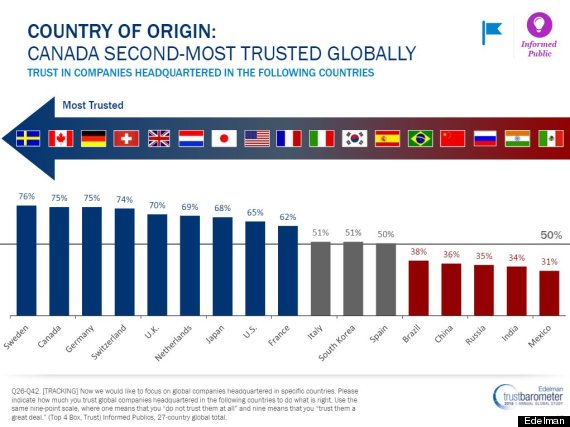
Canadian citizens are, for the most part, highly respected around the world. In fact, it is a matter of national pride that a Canadian can travel just about anywhere in the world, and as long as he or she displays a Canadian flag, open doors and smiles will be plentiful. However, an article in The Huffinton Post from the 9th of February 2015 entitled Canadian Businesses 2nd-Most Trusted In The World: Survey drew attention to the Ethical Debt balance sheet among Canadian companies. (Though they didn't call it that.)

The story points out that "Canada saw the largest drop in trust in business of any of the 27 countries surveyed." What this tells me is that Canadian companies are trading internationally on the reputation of our citizens. The rest of the world trusts Canadian businesses almost implicitly, but the people who know us best (those within our borders) don't trust us like they used to.

This is a wake-up call to all businesses. Correct your Ethical Debt before you have no reputation left upon which to trade.

WR