Showing posts with label Leadership. Show all posts

Wednesday, October 2, 2019

Risky Business

Business ownership involves risk. We all know that, but how much risk is too much risk? One's risk-tolerance is usually expressed, at least initially, as a qualitative statement about what one's "gut" says; something like "moderate", or "limited". Arguably, such statements are about as useful as a milk-bucket under a bull. So, the CISSP Common Body of Knowledge proposes a few quantitative formulas to help us out. Introducing the "Single Loss Expectancy" (SLE) and the "Annualized Loss Expectancy" (ALE).

Simply put, the SLE is the potential cost of a single event, and the ALE is the cost of such an event spread across all the years between events. Such formulas appeal to the executive members of organizations because they give actual numbers that can be used in making "fact-based" decisions. So, the cost of a particular event is $x, and the event can be reasonably expected to occur every y years. Your ALE becomes $x/y. Nice. Clean. Simple. Now we know what our risk on that given event will cost, and we can factor its management into the budget. Or can we?

Risk Management generally applies one or more of four strategies: Avoidance, Acceptance, Transference, and/or Mitigation. Avoidance means not doing whatever leads to the event in question. If the event is the loss of the entire executive team in a transportation accident, the risk can be avoided by not allowing the c-suite to travel at the same time. But if the risk is a breach of the computer network, deciding not to use networked computers may not be a viable solution. Acceptance means what you would expect; yes, there's a risk to the c-suite all traveling together, we acknowledge that risk but will keep doing it. This is an informed decision, no action required. Transference is making some other arrangement so that the risk is addressed in some other way. Buying what is known as Key-man Insurance on the entire c-suite would transfer the risk of them all being lost at sea to the insurance company (though I doubt this would be practical). Finally, mitigation is the handling of the risk. If the executive team never travel together, the risk of an empty c-suite due to a transportation accident is mitigated, though maybe not eliminated. Calculating the SLE of a particular threat is a natural part of the lead-up to a risk management plan. In order to determine a useful SLE however, one had better make sure the scope of the risk is adequately analysed.

As mentioned earlier, identifying the ALE is the process of determining how much a risk might cost over a given number of years. Common wisdom would say don't spend more than that amount trying to manage the risk. Furthermore, the more efficiently and effectively one can manage a risk, the better. The challenge however, is in accurately identifying all the composite parts of the risk event. Obviously, some risks have fewer moving parts than others. In the world of Cyber-security the knock on effects of an event can quickly become bigger than the event itself.

A case-in-point is the story of Danish hearing aid manufacturer Demant. On September 30th, ZDNet published the story discussing how a ransomware attack on Demant has cost the company $95M in one month. According to the story, Demant announced their trouble on the third of September, and by the publication date had not yet fully recovered. To be fair, I wouldn't begin to suggest that I know all that took place in this story, and admit that I am comfortably playing armchair analyst. However, I will make a few observations here as a thought experiment with the aim to help my readers avoid similar situations.

Of the risk management strategies discussed earlier, there is no way that Demant, or any other organization, could "avoid" a ransomware attack. Doing so would require disconnecting their computers from the internet, and maybe even getting rid of them all together. There is also no reason to suspect that Demant just "accepted" the risk and went about their business with their collective heads in the sand. Quite the opposite in fact. The story makes a couple of key points that illustrate that Demant included in their risk management a transference strategy. This is shown in that they have a $14.6 million cyber insurance policy. That is double the $7.3M required to recover and rebuild their IT infrastructure.
Demant Stock History (www.demant.com)

So if they had insurance for double the cost of their IT infrastructure, how did this event cost them $95M? According to the report, about half of that represents lost earnings, while the rest includes missed opportunity to implement a planned expansion. Demant seems to be a significant player in their field, and with stock prices still sitting at ~$25 per share, I would suspect they will rebound. But the question remains, how did this get so out of hand? Without inside knowledge, one is left to posit that the initial calculations of SLE did not take into account the amount of time it would take to restore the IT infrastructure and, by extension, the lost revenue during that time. I would also doubt that the individual calculating the SLE could have known that an expansion would be planned at the very time that the event occurred. It would be my guess that an assumption was made that new equipment would be bought, or existing equipment would be restored to factory defaults, and the back-ups would simply be applied. Done. Easy, right?

My grandfather used to say: "You don't get what you expect, you get what you inspect." While Demant can be credited for their implementation of a transference strategy, this story shows that transference is not necessarily enough. We can see that the risk from a ransomware attack could not be transferred to an insurance company because they only deal with the exchange of funds. In our earlier example, if the insurance company pays out the key-man policies, the company would still have to hire the replacements. Here, it would appear that though there were funds for the infrastructure, the restoration took significantly longer to execute than expected. This could be the result of corrupt back-up media, limited scope of back-ups, or any other number of failure points in the exercise. Unless one actually goes through the motions, and actually tries to restore from back-ups, one is rolling the dice. What would risk mitigation have looked like? Demant should have at least tested their ability to restore from back-ups. Or at an extreme, they could have had a complete segregated IT infrastructure sitting in the wings, ready to go at a moment's notice. While the setup of such an environment may have seemed cost prohibitive at the outset, the events that transpired over the past month show that greater mitigation was in fact warranted.


Photo credit: "Destiny" by Dave Gough (cc-by 2.0)

Monday, August 20, 2018

Live by the Code

Image of a knight by Gideon Wright, flickr.com CC-BY 2.0
Do you ever consider the word "nobility"? It has traditionally referred to a class of people who were born to privilege. It implied that since they had it "easy" they were called upon to be beyond reproach. It conjures images of knights in shining armour, and battles against injustice. Hollywood has kept such images alive for us long after chivalry has gone dormant. In one such movie: Robin Hood, Prince of Thieves (1991), our hero says "Nobility is not a birthright. It's defined by one's actions." I like that, and I believe it to be true. Anybody can have a code by which they choose to live, and for which they would willingly make sacrifices.

Such a code does not necessarily require sacrificing one's life, but it may require making sacrifices to one's livelihood. A good Code of Ethics is one such as the one below from the Association of Computing Machinery (acm.org). It's a commitment to one's peers, clients, and society at large. And while some may limit their adherence to this code to their professional life, I would say that such a code should apply to all aspects of one's life.

Being ethical is not just a 9-to-5 job. It's a way of life... it's a nobility. Is it in you?

  1. ACM Code of Ethics and Professional Conduct

    Preamble

    Computing professionals' actions change the world. To act responsibly, they should reflect upon the wider impacts of their work, consistently supporting the public good. The ACM Code of Ethics and Professional Conduct ("the Code") expresses the conscience of the profession.
    The Code is designed to inspire and guide the ethical conduct of all computing professionals, including current and aspiring practitioners, instructors, students, influencers, and anyone who uses computing technology in an impactful way. Additionally, the Code serves as a basis for remediation when violations occur. The Code includes principles formulated as statements of responsibility, based on the understanding that the public good is always the primary consideration. Each principle is supplemented by guidelines, which provide explanations to assist computing professionals in understanding and applying the principle.
    Section 1 outlines fundamental ethical principles that form the basis for the remainder of the Code. Section 2 addresses additional, more specific considerations of professional responsibility. Section 3 guides individuals who have a leadership role, whether in the workplace or in a volunteer professional capacity. Commitment to ethical conduct is required of every ACM member, and principles involving compliance with the Code are given in Section 4.
    The Code as a whole is concerned with how fundamental ethical principles apply to a computing professional's conduct. The Code is not an algorithm for solving ethical problems; rather it serves as a basis for ethical decision-making. When thinking through a particular issue, a computing professional may find that multiple principles should be taken into account, and that different principles will have different relevance to the issue. Questions related to these kinds of issues can best be answered by thoughtful consideration of the fundamental ethical principles, understanding that the public good is the paramount consideration. The entire computing profession benefits when the ethical decision-making process is accountable to and transparent to all stakeholders. Open discussions about ethical issues promote this accountability and transparency.

    1. GENERAL ETHICAL PRINCIPLES.

    A computing professional should...

    1.1 Contribute to society and to human well-being, acknowledging that all people are stakeholders in computing.

    This principle, which concerns the quality of life of all people, affirms an obligation of computing professionals, both individually and collectively, to use their skills for the benefit of society, its members, and the environment surrounding them. This obligation includes promoting fundamental human rights and protecting each individual's right to autonomy. An essential aim of computing professionals is to minimize negative consequences of computing, including threats to health, safety, personal security, and privacy. When the interests of multiple groups conflict, the needs of those less advantaged should be given increased attention and priority.
    Computing professionals should consider whether the results of their efforts will respect diversity, will be used in socially responsible ways, will meet social needs, and will be broadly accessible. They are encouraged to actively contribute to society by engaging in pro bono or volunteer work that benefits the public good.
    In addition to a safe social environment, human well-being requires a safe natural environment. Therefore, computing professionals should promote environmental sustainability both locally and globally.

    1.2 Avoid harm.

    In this document, "harm" means negative consequences, especially when those consequences are significant and unjust. Examples of harm include unjustified physical or mental injury, unjustified destruction or disclosure of information, and unjustified damage to property, reputation, and the environment. This list is not exhaustive.
    Well-intended actions, including those that accomplish assigned duties, may lead to harm. When that harm is unintended, those responsible are obliged to undo or mitigate the harm as much as possible. Avoiding harm begins with careful consideration of potential impacts on all those affected by decisions. When harm is an intentional part of the system, those responsible are obligated to ensure that the harm is ethically justified. In either case, ensure that all harm is minimized.
    To minimize the possibility of indirectly or unintentionally harming others, computing professionals should follow generally accepted best practices unless there is a compelling ethical reason to do otherwise. Additionally, the consequences of data aggregation and emergent properties of systems should be carefully analyzed. Those involved with pervasive or infrastructure systems should also consider Principle 3.7.
    A computing professional has an additional obligation to report any signs of system risks that might result in harm. If leaders do not act to curtail or mitigate such risks, it may be necessary to "blow the whistle" to reduce potential harm. However, capricious or misguided reporting of risks can itself be harmful. Before reporting risks, a computing professional should carefully assess relevant aspects of the situation.

    1.3 Be honest and trustworthy.

    Honesty is an essential component of trustworthiness. A computing professional should be transparent and provide full disclosure of all pertinent system capabilities, limitations, and potential problems to the appropriate parties. Making deliberately false or misleading claims, fabricating or falsifying data, offering or accepting bribes, and other dishonest conduct are violations of the Code.
    Computing professionals should be honest about their qualifications, and about any limitations in their competence to complete a task. Computing professionals should be forthright about any circumstances that might lead to either real or perceived conflicts of interest or otherwise tend to undermine the independence of their judgment. Furthermore, commitments should be honored.
    Computing professionals should not misrepresent an organization's policies or procedures, and should not speak on behalf of an organization unless authorized to do so.

    1.4 Be fair and take action not to discriminate.

    The values of equality, tolerance, respect for others, and justice govern this principle. Fairness requires that even careful decision processes provide some avenue for redress of grievances.
    Computing professionals should foster fair participation of all people, including those of underrepresented groups. Prejudicial discrimination on the basis of age, color, disability, ethnicity, family status, gender identity, labor union membership, military status, nationality, race, religion or belief, sex, sexual orientation, or any other inappropriate factor is an explicit violation of the Code. Harassment, including sexual harassment, bullying, and other abuses of power and authority, is a form of discrimination that, amongst other harms, limits fair access to the virtual and physical spaces where such harassment takes place.
    The use of information and technology may cause new, or enhance existing, inequities. Technologies and practices should be as inclusive and accessible as possible and computing professionals should take action to avoid creating systems or technologies that disenfranchise or oppress people. Failure to design for inclusiveness and accessibility may constitute unfair discrimination.

    1.5 Respect the work required to produce new ideas, inventions, creative works, and computing artifacts.

    Developing new ideas, inventions, creative works, and computing artifacts creates value for society, and those who expend this effort should expect to gain value from their work. Computing professionals should therefore credit the creators of ideas, inventions, work, and artifacts, and respect copyrights, patents, trade secrets, license agreements, and other methods of protecting authors' works.
    Both custom and the law recognize that some exceptions to a creator's control of a work are necessary for the public good. Computing professionals should not unduly oppose reasonable uses of their intellectual works. Efforts to help others by contributing time and energy to projects that help society illustrate a positive aspect of this principle. Such efforts include free and open source software and work put into the public domain. Computing professionals should not claim private ownership of work that they or others have shared as public resources.

    1.6 Respect privacy.

    The responsibility of respecting privacy applies to computing professionals in a particularly profound way. Technology enables the collection, monitoring, and exchange of personal information quickly, inexpensively, and often without the knowledge of the people affected. Therefore, a computing professional should become conversant in the various definitions and forms of privacy and should understand the rights and responsibilities associated with the collection and use of personal information.
    Computing professionals should only use personal information for legitimate ends and without violating the rights of individuals and groups. This requires taking precautions to prevent re-identification of anonymized data or unauthorized data collection, ensuring the accuracy of data, understanding the provenance of the data, and protecting it from unauthorized access and accidental disclosure. Computing professionals should establish transparent policies and procedures that allow individuals to understand what data is being collected and how it is being used, to give informed consent for automatic data collection, and to review, obtain, correct inaccuracies in, and delete their personal data.
    Only the minimum amount of personal information necessary should be collected in a system. The retention and disposal periods for that information should be clearly defined, enforced, and communicated to data subjects. Personal information gathered for a specific purpose should not be used for other purposes without the person's consent. Merged data collections can compromise privacy features present in the original collections. Therefore, computing professionals should take special care for privacy when merging data collections.

    1.7 Honor confidentiality.

    Computing professionals are often entrusted with confidential information such as trade secrets, client data, nonpublic business strategies, financial information, research data, pre-publication scholarly articles, and patent applications. Computing professionals should protect confidentiality except in cases where it is evidence of the violation of law, of organizational regulations, or of the Code. In these cases, the nature or contents of that information should not be disclosed except to appropriate authorities. A computing professional should consider thoughtfully whether such disclosures are consistent with the Code.

    2. PROFESSIONAL RESPONSIBILITIES.

    A computing professional should...

    2.1 Strive to achieve high quality in both the processes and products of professional work.

    Computing professionals should insist on and support high quality work from themselves and from colleagues. The dignity of employers, employees, colleagues, clients, users, and anyone else affected either directly or indirectly by the work should be respected throughout the process. Computing professionals should respect the right of those involved to transparent communication about the project. Professionals should be cognizant of any serious negative consequences affecting any stakeholder that may result from poor quality work and should resist inducements to neglect this responsibility.

    2.2 Maintain high standards of professional competence, conduct, and ethical practice.

    High quality computing depends on individuals and teams who take personal and group responsibility for acquiring and maintaining professional competence. Professional competence starts with technical knowledge and with awareness of the social context in which their work may be deployed. Professional competence also requires skill in communication, in reflective analysis, and in recognizing and navigating ethical challenges. Upgrading skills should be an ongoing process and might include independent study, attending conferences or seminars, and other informal or formal education. Professional organizations and employers should encourage and facilitate these activities.

    2.3 Know and respect existing rules pertaining to professional work.

    "Rules" here include local, regional, national, and international laws and regulations, as well as any policies and procedures of the organizations to which the professional belongs. Computing professionals must abide by these rules unless there is a compelling ethical justification to do otherwise. Rules that are judged unethical should be challenged. A rule may be unethical when it has an inadequate moral basis or causes recognizable harm. A computing professional should consider challenging the rule through existing channels before violating the rule. A computing professional who decides to violate a rule because it is unethical, or for any other reason, must consider potential consequences and accept responsibility for that action.

    2.4 Accept and provide appropriate professional review.

    High quality professional work in computing depends on professional review at all stages. Whenever appropriate, computing professionals should seek and utilize peer and stakeholder review. Computing professionals should also provide constructive, critical reviews of others' work.

    2.5 Give comprehensive and thorough evaluations of computer systems and their impacts, including analysis of possible risks.

    Computing professionals are in a position of trust, and therefore have a special responsibility to provide objective, credible evaluations and testimony to employers, employees, clients, users, and the public. Computing professionals should strive to be perceptive, thorough, and objective when evaluating, recommending, and presenting system descriptions and alternatives. Extraordinary care should be taken to identify and mitigate potential risks in machine learning systems. A system for which future risks cannot be reliably predicted requires frequent reassessment of risk as the system evolves in use, or it should not be deployed. Any issues that might result in major risk must be reported to appropriate parties.

    2.6 Perform work only in areas of competence.

    A computing professional is responsible for evaluating potential work assignments. This includes evaluating the work's feasibility and advisability, and making a judgment about whether the work assignment is within the professional's areas of competence. If at any time before or during the work assignment the professional identifies a lack of a necessary expertise, they must disclose this to the employer or client. The client or employer may decide to pursue the assignment with the professional after additional time to acquire the necessary competencies, to pursue the assignment with someone else who has the required expertise, or to forgo the assignment. A computing professional's ethical judgment should be the final guide in deciding whether to work on the assignment.
    As appropriate to the context and one's abilities, computing professionals should share technical knowledge with the public, foster awareness of computing, and encourage understanding of computing. These communications with the public should be clear, respectful, and welcoming. Important issues include the impacts of computer systems, their limitations, their vulnerabilities, and the opportunities that they present. Additionally, a computing professional should respectfully address inaccurate or misleading information related to computing.

    2.8 Access computing and communication resources only when authorized or when compelled by the public good.

    Individuals and organizations have the right to restrict access to their systems and data so long as the restrictions are consistent with other principles in the Code. Consequently, computing professionals should not access another's computer system, software, or data without a reasonable belief that such an action would be authorized or a compelling belief that it is consistent with the public good. A system being publicly accessible is not sufficient grounds on its own to imply authorization. Under exceptional circumstances a computing professional may use unauthorized access to disrupt or inhibit the functioning of malicious systems; extraordinary precautions must be taken in these instances to avoid harm to others.

    2.9 Design and implement systems that are robustly and usably secure.

    Breaches of computer security cause harm. Robust security should be a primary consideration when designing and implementing systems. Computing professionals should perform due diligence to ensure the system functions as intended, and take appropriate action to secure resources against accidental and intentional misuse, modification, and denial of service. As threats can arise and change after a system is deployed, computing professionals should integrate mitigation techniques and policies, such as monitoring, patching, and vulnerability reporting. Computing professionals should also take steps to ensure parties affected by data breaches are notified in a timely and clear manner, providing appropriate guidance and remediation.
    To ensure the system achieves its intended purpose, security features should be designed to be as intuitive and easy to use as possible. Computing professionals should discourage security precautions that are too confusing, are situationally inappropriate, or otherwise inhibit legitimate use.
    In cases where misuse or harm are predictable or unavoidable, the best option may be to not implement the system.

    3. PROFESSIONAL LEADERSHIP PRINCIPLES.

    Leadership may either be a formal designation or arise informally from influence over others. In this section, "leader" means any member of an organization or group who has influence, educational responsibilities, or managerial responsibilities. While these principles apply to all computing professionals, leaders bear a heightened responsibility to uphold and promote them, both within and through their organizations.
    A computing professional, especially one acting as a leader, should...

    3.1 Ensure that the public good is the central concern during all professional computing work.

    People—including users, customers, colleagues, and others affected directly or indirectly—should always be the central concern in computing. The public good should always be an explicit consideration when evaluating tasks associated with research, requirements analysis, design, implementation, testing, validation, deployment, maintenance, retirement, and disposal. Computing professionals should keep this focus no matter which methodologies or techniques they use in their practice.

    3.2 Articulate, encourage acceptance of, and evaluate fulfillment of social responsibilities by members of the organization or group.

    Technical organizations and groups affect broader society, and their leaders should accept the associated responsibilities. Organizations—through procedures and attitudes oriented toward quality, transparency, and the welfare of society—reduce harm to the public and raise awareness of the influence of technology in our lives. Therefore, leaders should encourage full participation of computing professionals in meeting relevant social responsibilities and discourage tendencies to do otherwise.

    3.3 Manage personnel and resources to enhance the quality of working life.

    Leaders should ensure that they enhance, not degrade, the quality of working life. Leaders should consider the personal and professional development, accessibility requirements, physical safety, psychological well-being, and human dignity of all workers. Appropriate human-computer ergonomic standards should be used in the workplace.

    3.4 Articulate, apply, and support policies and processes that reflect the principles of the Code.

    Leaders should pursue clearly defined organizational policies that are consistent with the Code and effectively communicate them to relevant stakeholders. In addition, leaders should encourage and reward compliance with those policies, and take appropriate action when policies are violated. Designing or implementing processes that deliberately or negligently violate, or tend to enable the violation of, the Code's principles is ethically unacceptable.

    3.5 Create opportunities for members of the organization or group to grow as professionals.

    Educational opportunities are essential for all organization and group members. Leaders should ensure that opportunities are available to computing professionals to help them improve their knowledge and skills in professionalism, in the practice of ethics, and in their technical specialties. These opportunities should include experiences that familiarize computing professionals with the consequences and limitations of particular types of systems. Computing professionals should be fully aware of the dangers of oversimplified approaches, the improbability of anticipating every possible operating condition, the inevitability of software errors, the interactions of systems and their contexts, and other issues related to the complexity of their profession—and thus be confident in taking on responsibilities for the work that they do.

    3.6 Use care when modifying or retiring systems.

    Interface changes, the removal of features, and even software updates have an impact on the productivity of users and the quality of their work. Leaders should take care when changing or discontinuing support for system features on which people still depend. Leaders should thoroughly investigate viable alternatives to removing support for a legacy system. If these alternatives are unacceptably risky or impractical, the developer should assist stakeholders' graceful migration from the system to an alternative. Users should be notified of the risks of continued use of the unsupported system long before support ends. Computing professionals should assist system users in monitoring the operational viability of their computing systems, and help them understand that timely replacement of inappropriate or outdated features or entire systems may be needed.

    3.7 Recognize and take special care of systems that become integrated into the infrastructure of society.

    Even the simplest computer systems have the potential to impact all aspects of society when integrated with everyday activities such as commerce, travel, government, healthcare, and education. When organizations and groups develop systems that become an important part of the infrastructure of society, their leaders have an added responsibility to be good stewards of these systems. Part of that stewardship requires establishing policies for fair system access, including for those who may have been excluded. That stewardship also requires that computing professionals monitor the level of integration of their systems into the infrastructure of society. As the level of adoption changes, the ethical responsibilities of the organization or group are likely to change as well. Continual monitoring of how society is using a system will allow the organization or group to remain consistent with their ethical obligations outlined in the Code. When appropriate standards of care do not exist, computing professionals have a duty to ensure they are developed.

    4. COMPLIANCE WITH THE CODE.

    A computing professional should...

    4.1 Uphold, promote, and respect the principles of the Code.

    The future of computing depends on both technical and ethical excellence. Computing professionals should adhere to the principles of the Code and contribute to improving them. Computing professionals who recognize breaches of the Code should take actions to resolve the ethical issues they recognize, including, when reasonable, expressing their concern to the person or persons thought to be violating the Code.

    4.2 Treat violations of the Code as inconsistent with membership in the ACM.

    Each ACM member should encourage and support adherence by all computing professionals regardless of ACM membership. ACM members who recognize a breach of the Code should consider reporting the violation to the ACM, which may result in remedial action as specified in the ACM's Code of Ethics and Professional Conduct Enforcement Policy.

    The Code and guidelines were developed by the ACM Code 2018 Task Force: Executive Committee Don Gotterbarn (Chair), Bo Brinkman, Catherine Flick, Michael S Kirkpatrick, Keith Miller, Kate Varansky, and Marty J Wolf. Members: Eve Anderson, Ron Anderson, Amy Bruckman, Karla Carter, Michael Davis, Penny Duquenoy, Jeremy Epstein, Kai Kimppa, Lorraine Kisselburgh, Shrawan Kumar, Andrew McGettrick, Natasa Milic-Frayling, Denise Oram, Simon Rogerson, David Shama, Janice Sipior, Eugene Spafford, and Les Waguespack. The Task Force was organized by the ACM Committee on Professional Ethics. Significant contributions to the Code were also made by the broader international ACM membership. This Code and its guidelines were adopted by the ACM Council on June 22nd, 2018.
    This Code may be published without permission as long as it is not changed in any way and it carries the copyright notice. Copyright (c) 2018 by the Association for Computing Machinery.

Sunday, November 13, 2016

Democrazy

Maybe it's time we re-think this whole "Democracy" thing. I am not proposing Communism (though in its pure form would be better than Democracy), and I am not proposing Anarchy (which in its pure form is better than Communism). However, it seems obvious to me after watching the turmoil surrounding the Arab Spring, the Brexit vote, the Trump victory, and numerous Canadian elections, that "Democracy", as it is currently implemented, is broken. It is time to move away from party politics and embrace direct representation.

I think it is time for "Democracy 2.0".

Before I go further, let me stress two things:
I am a layman. I have no political training whatsoever.
I don’t want to lead you. I have no political aspirations whatsoever.
What I do have is a desire to see mankind live in peace, and to see governments actually represent their people.

If you continue to do what you’ve always done, 
you will continue to see what you’ve always seen.

What’s wrong with the status-quo? When I reflect on the lack of direct representation in democracy, there is one thing that repeatedly jumps out at me: The Party Political Model. Under the party model, one person is appointed leader (or assumes leadership) of the party. This leader establishes the platform that the party rallies behind. The party then goes out into the country (or province), and places a candidate in each electoral district (or riding) that they can afford to. On Election Day, you (the people) then choose the party (and its leader) whose platform closest relates to your personal set of priorities. In Canada, this usually boils down to a decision between Liver & Onions or Onions & Liver. The local politician has very little say as to what issues are important, and is often bullied into voting the party line, especially on issues of significance. Your voice is heard only once every four years.
Based on photo by Arthur Chapman CC BY-NC-SA 2.0
In English, when one wants to say that something is out of order, one often says that “the cart is before the horse.” This is the current state of Democracy. As long as the leader of government is chosen before the members of government, the members will represent the leader before their constituents. This may have been needed at a time when most people had no way of knowing what a particular candidate’s opinion on the issues was. So, the party was trusted to assemble like-minded representatives. However, with the advent of the internet, and even more so Social Media, a constituent can know everything there is to know about a candidate. Fancy a life in politics? You had better keep your digital footprint clean.

Democracy 2.0 in Action

What would Democracy 2.0 look like? For starters, the size of the constituency would be based on the number of people an average representative can actually represent. I don’t know what that number is, that would require further research. But think of it this way, if a representative were to speak with a different constituent every half hour, seven hours a day, every week day for fifty weeks of the year, s/he could hear the opinions of 3,500 constituents. If the size of the constituency is 100,000 people, the opinions of those 3,500 constituents would reflect the entire population of the constituency 95% of the time with a 1.63 margin of error. (As an aside, the average population of Canadian federal ridings is 99,034.)

In Canada, we have a situation that doesn’t occur everywhere, but must be addressed in all countries where it does occur. Since the formation of Canada was the result of colonialization, we have an indigenous population. Our indigenous population is known as the “First Nations.” Due to the sleight of hand and wordsmithing skills of the colonial forces (not to mention military might), the First Nations are not represented equally in government. Under Democracy 2.0, each Nation of the First Nations would have a seat in government. We cannot undo the past, but we can fix the future.

So, now that we’ve nailed down the size of the constituency, let’s discuss candidates. All candidates that wish to represent a constituency must actually be from that constituency. Under the party model, it is not un-common for a party to move a candidate to a constituency where they cannot, or will not, field someone local. That person knows nothing about life in that area, and cannot possibly have a vested interest in the wellbeing of that community. If we remove the parties, we open the door to direct representation. The electorate focuses their decision making on choosing the candidate that best represents their beliefs and concerns.

You might ask: what about Leadership, and Opposition? How would that work? I would reply: ask yourself this: what do you expect the Opposition to do? Oppose. But what should they do when the law being debated has merit? Do you really want someone to sit in opposition to something they know to be right? Under Democracy 2.0, all members of the House of Representatives are members of the Government, and all members of the House of Representatives are members of the Opposition. Under Democracy 2.0, they are all expected to consider each bill or act (or whatever you call them in your context) under its own merit. Each representative can propose a bill for consideration by his or her peers, but there is no one person who is sitting in a position of authority over them. As such, there is no one person who influences their vote.

The role of Leader would be occupied by a member of the House of Representatives chosen by his or her peers. For this, I like the British term “Prime Minister.” This would be the first among equals, the Head of State. One must note however, that this position is external facing. As each representative is accountable to his or her constituency, this Prime Minister would be accountable to the House of Representatives, and would be expected to represent their beliefs and concerns on the world stage.

A Brave New World

The beauty of the Democracy 2.0 model is that it would scale really well. The same model could be applied to local governments, provincial (or state) governments, even to multilateral organizations like the United Nations. The challenge is making it a reality. The political machines that drive democratic implementations around the world are protectionist in nature, and are not likely to change from the inside. It would take a true statesman or stateswoman to give up power once granted the majority required to make Democracy 2.0 happen. But I can always dream.

Wednesday, May 11, 2016

The Culture of Poverty

From "The Devil's Miner"
I watched a report by Mathias Meier in the New York Times entitled "Embracing Child Labor". Bolivia, my birthplace, has made it legal for children to begin working at ten years of age.  I must say I am shocked and saddened. I am shocked that this has barely received any press in the developed world, and I am saddened to think of what this will mean for the future of these beautiful people.

I understand the logic of the proponents of child labour. The families are starving, the children are working already, let's make sure that they at least get a fair wage. In fairness, child labour happens to some degree all over the world. Even in North America, on family farms children are expected to perform duties before and after school that are critical to keeping the farm running. The same is true in many family run businesses in Bolivia, but this is not what we are talking about here. Here we are talking about children working at hard labour (mining, brick making, etc), and though it is not supposed to interfere with schooling, one would have to be quite naive to think that it doesn't.

In the above story, Dr. Jorge Domic, the director of Fundación La Paz (a development NGO), says that child labour is part of the Andean culture, and especially Bolivian culture. I beg to differ. Culture is not what a people do, it is who a people are. Culture is the characteristics of a people that distinguishes them from their neighbours. Being hard working and industrious can be seen as cultural. Keeping a segment of one's population poor due to lack of education is not cultural. Despite the promise of a socialist revolution, it is the rich in Bolivia that are profiting from this move, not the poor. Oh sure, the poor will get a few extra pennies, and that will make a difference, but it will be just enough to keep them poor. And by legalizing child labour, families who would have otherwise obeyed the law and endured the hardship of poverty, might be tempted by the newly legalized source of income.

According to the CIA World Factbook, 45% of Bolivians live on less that $2 per day. The Factbook also points out that:
"Bolivia's income inequality is the highest in Latin America and one of the highest in the world. Public education is of poor quality, and educational opportunities are among the most unevenly distributed in Latin America, with girls and indigenous and rural children less likely to be literate or to complete primary school."
So there's your problem. A third of the population is under the age of 15, you have a low quality system of public education, and the access to public education is not universal. Now you are going to compound the problem by making it OK for children to work for pay starting at ten years of age (and their "union" is pushing for that age to be lower still). I like how Alex Rosen put it in his article on this topic in "No Se Mancha":
"If this is Bolivia’s best answer, then perhaps they have asked the wrong question."
What is needed is a break in the cycle of generational poverty. This can only be accomplished by a high quality, universal, public education system. President Morales has done his people a huge disservice.

Thursday, March 31, 2016

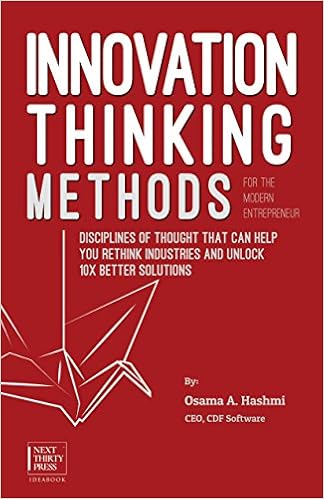
Entrepreneur: Disciplines of Thought That Can Help You Rethink Industries and Unlock 10x Better Solutions - A Review

What is "Innovative Thinking"? Is it something that can be taught?

It would appear that Osama A. Hashmi's answer is a definite... maybe. I must admit that when I first saw the title Entrepreneur: Disciplines of Thought That Can Help You Rethink Industries and Unlock 10x Better Solutions I was skeptical at best. However, being a bit of a business strategy junky, I put my doubts aside and gave it a read.

Hashmi's writing style is very accessible. He doesn't bog you down with pseudo-science as many business writers do, but rather leaves you feeling like you just had a good long chat with as friend at a corner coffee shop. With nice short chapters, it feels more like a conversation than a lecture. It's the kind of book that you can fit into a busy life, a little here and a little there.

"OK Waldo, you like the format, what about the content?"
It's hard to point out a flaw in the content, mainly because there's little new. However that is, in itself, a positive thing. After all, there is something terrifying about a "completely new process of thought." That's not to say that the content is in some way lacking. Hashmi presents his ideas with a clarity that makes them easy to understand. If you're like me, you will find this little book more reassuring than revolutionary.

Of course, there is a problem with the book. That problem I have with it is the same problem I started with... the title. "Unlock 10x Better Solutions"... really? Hashmi himself has included a chapter entitled "To  Innovate, Stop  Listening  to Bozos  Like  me." If you finish this book and don't feel a little cheated by the title, then you are either a quite young, or new to the world of business.

So should you read this book? Most definitely. It's not so much what the author TELLS you, but what he ASKS you. Again, you walk away from each chapter feeling like you just had a really good chat with a friend. In the cut-throat world of business, that has tremendous value.

Monday, August 31, 2015

Contracts Written in Disappearing Ink

Credit: Peter Kaminski
They say "A Picture Paints A Thousand Words." If that is the case, then it stands to reason that a thousand words must paint a picture. But what happens to the picture if you start to erase some of the words?

According to Mario Elia; a Doctor from London, Ontario; this is what the Province of Ontario is doing with it's contract with Physicians. They agreed to a certain rate of pay, but are now changing the game to suit their own purpose. Essentially, they have made election promises and expect the doctors to pay the bill.

Now I'm not going to get into the political side of this issue. We are currently under Liberal Party rule, but the same thing was done by the New Democrats under Bob Rae (referred to colloquially as Bob Rae Days), and the Progressive Conservatives under Mike Harris made dramatic cuts to health care as well. I personally have a very difficult time trusting any politician.

This story is, however, an excellent illustration of #EthicalDebt at play.When (if) our government goes back to the bargaining table, our physicians (if there are any left in Ontario) will have a hard time agreeing to any contract. They will be, justifiably so, suspicious that the contract may be written in disappearing ink. I chose the image that accompanies this post because the artist says:
« The [Buddha] board has a sandstone-like texture that turns ink-black when you paint on it with plain water. Over the course of 20-30 minutes, the water evaporates, and your drawing disappears. »
For how long is your signature a sign of your commitment?

Do your contracts (or the spirit within which they were signed) only last as long as circumstances are in your favour? ...or do you stand by your word?

If I asked your business associates or customers the same question, would their answers agree with yours?

So, you are different. That's great! What about the people you manage? Have you said one thing, but put your people in a position that they can never deliver? Have you already identified the "scape goat" for your failed promise?

Ethical Debt is a line item on your moral balance sheet. You can talk all you want about honesty and transparency, but when the people look at the picture that is you, does the image align with what the public relations department has painted, or were they painting on a Buddha Board?

Saturday, August 15, 2015

The Keys To Collaboration - A Review

They say Teamwork Makes the Dream Work. Unfortunately, teamwork can also cause nightmares. In The Keys To Collaboration: How to Build A Great Team or Fix the One You've Got, Lane Sherman provides practical and actionable guidance for success among teams. Many books on the subject of teamwork rely on broken metaphors or sports analogies. This book is for the busy professional who doesn't want to waste time reading such drivel, but wants some clear, no-nonsense direction.

In Part One, Mr. Sherman correctly points out that not all collections of individuals working toward a common goal are actually teams. An often overlooked consideration is the difference between Working Groups and Teams. This distinction is critical for leaders, as all other collaboration efforts hinge upon it. He then goes into the details of his Five Key Factors of Collaboration and explains the tasks that you, as a leader, will need to undertake.

In Part Two, the author guides you through the key conversations that will ensure that the team members are equipped for success. These conversations are related back to his Five Key Factors in a manner that is easy to understand and builds upon the foundation that was built in Part One.

Part Three covers the day to day management of the team. It is interesting to note that while entire books have been written on this part, it is one of the smallest parts in the book. This is the main differentiator between this book and others that you may have read on the subject of teams. The mechanics of team leadership are actually pretty basic. However without the first two parts, perfect execution of management does not guarantee success... which then makes the fourth part of this book so critical.

Part Four is most likely the reason you will purchase this book. Either something went wrong and now you need to fix it; or you want to avoid the dysfunctional teams you've had in the past. Here, the author provides six steps that again, build upon the foundation of his Five Key Factors of Collaboration to guide the team back to the path of success. Even if you are just starting a new team, this is an important section so that warning signs can be identified and corrections made early.

Parts Five and Six deal with tools and activities that will be very useful to most teams, but especially remote teams.

With almost 20 years of professional experience working with both groups and teams, I can vouch for the value of this book. You will certainly find yourself referring to it again and again, especially if you collaborate with dynamic teams.

Monday, June 22, 2015

Who's Your Best Teacher?

Your best teacher is your last mistake.
Unknown image source. Please advise if you know who to credit.
I saw this today, and initially thought "yeah, that seems true," but then I quickly changed my mind. While recognizing the lessons that a mistake teaches is important, there exist many better teachers. The problem with this statement is that some mistakes are so expensive that they may render the lesson useless.

I occasionally say "Nobody is completely useless, they can always serve as a bad example." A better teacher is someone else's mistake. The beauty of this teacher is that it doesn't cost you anything.

Now if you just spend your time looking at other people's mistakes, you may be making the mistake of not focussing on your own business. That's where Management Consultants come in. Yes I know, we're not free (in fact most are not cheap either), but the money invested in hiring a management consultant can at least be budgeted.

So, your "best" teacher may actually be a management consultant. You focus on running your business, and hire me to address the concerns that are keeping you up at night.

Let's talk. Give me a call for a free consultation.

Thursday, May 14, 2015

Company Culture vs. Freedom of Speech

Credit: Manymeez
Ontario's electricity distribution company, Hydro One, has fired an employee for interrupting a live interview with the now famous FHRITP taunt. For those of you who are not familiar with the FHRITP taunt, it equates less vulgarly to "have sexual intercourse with her". The language used is quite profane and the way it is delivered, in this case anyways, is one of encouraging the male being interviewed to not take the lady seriously, and to view her merely as a sex toy.

So now that I have given you the background, let's discuss Hydro One CEO Carmine Marcello's decision to fire the individual in question. Some people have pointed out that the individual in question was not, at the time of the incident, representing Hydro One; and in fact, even Marcello acknowledged that the Hydro One leadership didn't know that he was an employee when they first discussed it. This person was not wearing any Hydro One branding, so Hydro One's reputation was not at stake. For these reasons, may people feel that he is being unfairly punished for exercising his freedom of speech. Many people feel he shouldn't have been punished at all, while others feel that the punishment was too severe.

I submit to you that he is not being punished at all. He is merely experiencing the consequences for his actions. He had, and exercised, the right to say whatever he wanted wherever he wanted to say it. Good for him. Was the statement that he made worth losing his job over? ...his reputation? ...his pension? I kind of doubt it. It's not like he was protesting some great injustice. He was being a buffoon. He was wasting the fifteen minutes of fame to which we are supposedly all entitled.

What about Hydro One? While their former employee had the right to free speech, I would suggest that Hydro One has the right to determine what kind of person fits in its culture, and what kind does not. Somebody who is willing to use that kind of language on a public (and recorded) platform, would also use that kind of language in a private setting where, perhaps, a single female employee is surrounded by men. This is not a question of defending Hydro One's reputation. This is a question of showing the women who work for Hydro One that the statements of equality that they make are not mere rhetoric. It is a question of doing what is right, regardless of the fallout.

No doubt some left-wing labour lawyer is going to try to take Hydro One and Mr. Marcello to court over this dismissal. I hope that when the dust settles, a precedent is set that gives companies the courage to respond in a similar way in the future. Our mothers, wives, sisters, and daughters deserve more respect than morons such as this former Hydro One employee have demonstrated.

Well done Mr. Marcello and Hydro One! In my opinion, you have earned a healthy #EthicalCredit.

Friday, April 3, 2015

Blessed are the Flexible.

"Flexibility" credit: Shelley Rodrigo
Is agility in government even possible? According to a study by PriceWaterhouseCoopers and Canada's Public Policy Forum, it may be. While I would certainly applaud any effort to make government more effective and efficient, my experience in the software industry tells me that their biggest risk will be throwing the baby out with the bathwater.

Software development methodologies have evolved quite dramatically since the days of Alan Turing. Usually, its evolution was brought about by advances in technology that made the next methodology possible. Where programmers once had to manually colour in little numbered boxes on punch cards in order to convey their instructions, we can now write computer programs that are almost natural language. I don't imagine the day is too far off when computers will be programmed in a conversational manner similar to the science fiction of the 1980s.

I had the good fortune to witness the evolution into Agile Software Development. This approach did away with complex, fully documented designs that required multiple sign-offs in order to proceed, and even more sign-offs to change; and was intended to replace it with high-level designs, and multiple smaller steps allowing for course correction as needed. The problem that many development shops faced was that the move to "agility" was misinterpreted as doing away with all up-front design. They effectively threw their software babies out with the design bathwater. The promises of agility were often not realised because entire sections of code had to be rewritten for the lack of forward planning.

The authors of the above mentioned report make some very good observations. The identification of: Adaptability, Innovation, Collaboration, Visibility, and Velocity as key elements that define agility is a good start. Furthermore, the approaches they suggest for the public service leadership to achieve agility certainly have merit. However, I feel that two elements still threaten our proverbial baby. A clear definition of agile, and buy-in from all stakeholders.

It is imperative that the pillars of public service such as accountability, effectiveness, and efficiency be preserved. They may be modified to reflect the new reality, however they must not be abandoned in the same way that many programmers abandoned forward planning. As a tax payer, I still expect my government to work for me in the most efficient and effective way, and I still expect them to be accountable. There is no more room for multi-million dollar boondoggles.

In order to succeed, this move to agility will involve a complete organizational transformation. Anyone who has studied the subject will tell you that one of the key elements to success in such transformation is obtaining stakeholder buy-in. And at the risk of sounding cynical, I suspect THAT will be the biggest hurdle. Whether it is the combative relationships between management and the various unions; or the partisan political influences on the civil service; or the arm twisting of the unions and other lobby groups on politicians; or the fiefdom building efforts of middle-managers; I find it very difficult to imagine a restructuring plan that would satisfy the various stakeholders enough that they would not only tolerate it, but become its champion.

I hope I am wrong. As with the software industry; when it is done correctly, there are huge benefits to be had by being agile and receptive to change.

There's a proverb to the effect of:
Blessed are the flexible.
They shall not get bent out of shape.

Here's to flexibility.

WR

Sunday, March 29, 2015

Let's Play Damage Control

Credit: US Navy (CC-by-2.0)
Have you ever tried to put toothpaste back in the tube? Maybe shaving cream back into the can? How about words back into your mouth? The first one is hard; the second one, much harder; the third... impossible.

I was reading a story today about a father of a young girl with #CerebralPalsy. Dad would regularly bring his daughter to a particular indoor play establishment in Guelph, Ontario. Though the establishment had a policy of socks only, an exception has always been made for this little girl because she needed to wear her shoes and braces in order to climb on the play structures. I don't want to mention names (against my instinct as a father of a special needs child), because I am trying to make a general point, not point out a single incident. Having said that, if you are on Facebook and live in or near Guelph, Ontario; you probably know to which incident I am referring. As it turned out, at this particular visit, the owner of the establishment was present, and enforced her rules much more stringently than any of her employees have in the past. The father and daughter were shown the door, and forced to drive to a neighbouring town to complete the play date. As a result of the angry posts of this girl's parents, the establishment in question was so overrun with negative feedback that they decided to shut down their Facebook page. Unfortunately for this company, all that they accomplished with that action is to remove themselves from the conversation. 

So, what went wrong? Well, as with most similar incidents, this is the result of a comedy of errors.
1) Employees should have brought the exception to the attention of management.
I understand that this would have been a tough thing to expect of an employee. "Uhm, boss, yesterday I broke the rules, and I thought you should know about it." But maybe, the first visit would have been the place to cut this off at the pass. If the owner had a reputation as being an ethical entrepreneur, her employees might have been willing to ask the father for his contact information and say "I'm sorry, but right now I have to enforce the rules. I will discuss this situation with my boss and have her call you to discuss what options are possible in the future." While the father and daughter would have still been upset, they would have had the comfort of knowing that it was not impossible, just not possible now.
2) The owner and the father should have looked for alternatives that would address all concerns.
Now I don't know what would have been a possible alternative, I know very little about Cerebral Palsy, but a dialog with two experts (the owner as an expert in play structures, and the father as an expert in Cerebral Palsy), must have been able to come up with alternatives. Would it be safe for the little girl to where dad's socks over top of her shoes and braces? If not dad's socks, perhaps some other rubberized covering.
3) The organization should have stayed in the conversation.
Here is the attempt at damage control that the owner put out on Facebook just before the page went down:
The parents have since argued (adequately in my opinion) the first two points.
It was bad enough that the owner didn't stay in the conversation directly with the parents. Had she done that, and conveyed a sense of empathy and a desire to find a solution, the parents would probably not have launched their campaign to boycott the establishment. The entire thing would have been resolved without threatening the bottom line. 
In fact, the parents would probably have bragged about the care that the establishment had given them and the owner may have been sitting on a nice Ethical Credit. Instead, buy "pleading the fifth" and shutting down the Facebook page, the owner is now burdened with Ethical Debt, from under which she may never escape.
In The Art of the Start 2.0, @Guy Kawasaki points out how lawyers should be used. Rather than asking a layer if you should do something, Kawasaki says that you should say "This is what I want to do. Now, keep me out of jail." In my opinion, if you need a lawyer's advice on how to handle an irate customer, you've let it go too far.

Saturday, March 28, 2015

What's the FUTURE of SHOPping?

Based on photo by Andrew Todd Phillips (CC-BY-SA-2.0)
Here we go again! CBC is reporting that another 1500 retail jobs are lost in Canada as Best Buy shuts down its Future Shop subsidiary. Best Buy bought Future Shop in 2001. I would have expected them to have sorted out the competing stores well before now.

I get it, big fish eat little fish, and there will always be a bigger fish. As I understand it, the employees are being well treated and presented with choices. But this still annoys me. Another Canadian brand dies at the hands of an American company.

The Government of Canada should force any companies that buy Canadian businesses to leave the country if they find that they cannot make it here, and restore the brands they destroyed. In this case, it should be the Best Buy stores that are closing, and the Future Shop stores that remain. It may sound like semantics, but every day, Canada is losing a little of its identity.

Admittedly, the real trouble is that Future Shop shareholders valued the $580M more than the pride of owning a piece of a successful Canadian brand. I suppose in hindsight, they are probably happy to have been rid of it instead of having to do battle with the American giant.

In the end, this is another example of a retailer shooting itself in the foot. They say it's because they are losing to online shopping, but they are hosting online shopping websites. Retailers have to provide value to the consumer that cannot be matched in the online world, and focus their efforts on that. Here's a common scenario. You go into a retailer and stand in the aisle comparing two products. Magically, a sales associate appears and asks if you need help. You say "Yes, I'd like to know what's different between these two brands other than the $50 price difference." And the well meaning sales associate proceeds to read the two boxes. You walk away thinking to yourself: "I should have just read the reviews online and ordered it there."


Monday, March 23, 2015

What Makes a Great Leader?

Credit: Scott Maxwell
I read a discussion today from McKinsey & Company entitled Decoding leadership: What really matters. The authors discuss a study they conducted to try to identify "what sort of leadership behavior organizations should encourage". It seems that the researchers really conducted an exhaustive study. I congratulate them on their work.

A survey 189,000 people in 81 medium to large organizations, identified 4 key leadership behaviours that the strongest leaders possess. While that is interesting, what I find alarming is that the list of "20 possible types of behavior" that they used does not include  any mention of Ethics or Integrity. In fairness, some of the behaviours might be seen as ethical traits, but they aren't traits that would prevent Ethical Debt.
Where is the mention of Honesty, Fairness, Trustworthiness, Beyond Reproach, etc. Sure number 9 is "Foster mutual respect", and while that is important, it doesn't scream out "Always do the right thing".

My grandfather used to be an accountant. I remember a story that I heard about him that went something like this:
Someone approached one of his clients and asked for an introduction to my grandfather as they were looking for someone to fix their books so that they wouldn't have to pay so much tax. Apparently, my grandfather's client told him "Don't bother asking Mr. Rochow, he would never do that kind of book-keeping."
That is the kind of ethics that all leaders should possess and cultivate in their organizations. You want a reputation that is so ethical that nobody would ever even consider asking you to do something that is not above board. That is the way to avoid Ethical Debt.