Showing posts with label Policy. Show all posts
Tuesday, February 11, 2020
Be Ransom-aware
Ransomware is a hot topic, and so it should be. It seems that every day there are news articles such as this recent piece from the New York Times that show the devastation that can be caused by a ransomware attack. A ransomware attack used to be little more than an annoyance. If you got hit, you would just restore your important files from back-ups, and carry on with your day. (You did make back-ups, didn't you?) Then, likely as a result of the increased threat of ransomware, we started backing up everything, all the time. Then the hackers started also encrypting our back-ups since they were on the network. Now, the hackers are being much more selective in their targets and going after large enough enterprises to make for a great pay-day. But those large enterprises wouldn't always pay. Now, smaller businesses would get hurt by the downtime experienced by the larger players in the supply chain. So the hackers started sharing sensitive files to prove that they had them, and to add blackmail to the ransom. (Hey, in for a penny, in for a pound. Right?) The internet is crying out for a solution, but few are provided. Unfortunately, there is no magic bullet.
What the problem calls for is some good old-fashioned risk analysis and mitigation. The reason ransomware works is because your data is valuable... even if to nobody else but you. If the hackers can't get at your data, you're golden. Unfortunately, most networks are completely open once the firewall is breached. (You did set up a firewall, didn't you?) Now before you start envisioning hackers wheeling up some medieval war machine to the edge of a moat, consider that the majority of security breaches are initiated from the inside. Social Engineering is responsible for more security violations than any other penetration method. So before you spend any money hardening your network, harden your staff. This involves more than just circulating a memo telling everyone to be careful. The reason there are companies dedicated to security awareness training is because it's hard work. However, purely from a bang-for-the-buck perspective, instilling a security mindset in your employees is the best investment.
Next on the risk-awareness parade is locking your doors. It is a security best practice to only grant access to those who have reason to access. Many, if not most, organizations mount network drives by default. While that makes getting data and transferring data quicker, it also makes it easy for hackers to travel from one computer to the entire network. As a result, the hacker often only needs to fool one person to get at everyone. Restricting access to other network devices to only the time that they are actually needed will stop an attacker from being able to browse with ease. Should all documents be available to everybody? Probably not, at least not all the time. Should database backups be available to the whole team? I doubt it. A hardened network may be inconvenient for your employees, but it is probably less inconvenient than looking for a new job because the company was shuttered after an attack.
Now that we have locked our doors, let's put things away. As mentioned earlier, the current trend among ransomware hackers is to look for files or data that may be sensitive and steal that to be used as blackmail if the ransom is not paid. This is where protecting data at rest comes into play. If all hard drives, devices, and databases are encrypted, The hackers won't have any way of knowing what is sensitive, and won't be able to use that as leverage.
This brings me to the backups themselves. Your risk analysis is going to have to take into account managing your backups. Backing up your databases and documents is only a small part of the equation... important, yes, but small. What good are the backups if you cannot access them? The ability to retrieve the data on backups is the real goal. Doing it quickly enough is almost as important. When considering the risk of a ransomware attack, one must consider how long the network can be shut down before losses become critical. For some companies, an hour may feel like an eternity. For others a week could go by and they could still recover. For the latter, it may be sufficient to do daily backups and rotate them with off site storage once a week. For the former, a near real-time duplicate network and database may be the only option.
Obviously, this brief discussion is sadly superficial. Each business/organization is different, and each requires a different set of components in its security strategy. The security measures themselves must also be applied within reason. Too strict, and the employees will find ways around them. Too lose, and they serve no purpose. The real message here is don't just wring your hands in fear. Take a strategic look at the threats you face and align it with your risk tolerance like you would any investment.
Wednesday, October 2, 2019
Risky Business
Business ownership involves risk. We all know that, but how much risk is too much risk? One's risk-tolerance is usually expressed, at least initially, as a qualitative statement about what one's "gut" says; something like "moderate", or "limited". Arguably, such statements are about as useful as a milk-bucket under a bull. So, the CISSP Common Body of Knowledge proposes a few quantitative formulas to help us out. Introducing the "Single Loss Expectancy" (SLE) and the "Annualized Loss Expectancy" (ALE).
Simply put, the SLE is the potential cost of a single event, and the ALE is the cost of such an event spread across all the years between events. Such formulas appeal to the executive members of organizations because they give actual numbers that can be used in making "fact-based" decisions. So, the cost of a particular event is $x, and the event can be reasonably expected to occur every y years. Your ALE becomes $x/y. Nice. Clean. Simple. Now we know what our risk on that given event will cost, and we can factor its management into the budget. Or can we?
Risk Management generally applies one or more of four strategies: Avoidance, Acceptance, Transference, and/or Mitigation. Avoidance means not doing whatever leads to the event in question. If the event is the loss of the entire executive team in a transportation accident, the risk can be avoided by not allowing the c-suite to travel at the same time. But if the risk is a breach of the computer network, deciding not to use networked computers may not be a viable solution. Acceptance means what you would expect; yes, there's a risk to the c-suite all traveling together, we acknowledge that risk but will keep doing it. This is an informed decision, no action required. Transference is making some other arrangement so that the risk is addressed in some other way. Buying what is known as Key-man Insurance on the entire c-suite would transfer the risk of them all being lost at sea to the insurance company (though I doubt this would be practical). Finally, mitigation is the handling of the risk. If the executive team never travel together, the risk of an empty c-suite due to a transportation accident is mitigated, though maybe not eliminated. Calculating the SLE of a particular threat is a natural part of the lead-up to a risk management plan. In order to determine a useful SLE however, one had better make sure the scope of the risk is adequately analysed.
As mentioned earlier, identifying the ALE is the process of determining how much a risk might cost over a given number of years. Common wisdom would say don't spend more than that amount trying to manage the risk. Furthermore, the more efficiently and effectively one can manage a risk, the better. The challenge however, is in accurately identifying all the composite parts of the risk event. Obviously, some risks have fewer moving parts than others. In the world of Cyber-security the knock on effects of an event can quickly become bigger than the event itself.
A case-in-point is the story of Danish hearing aid manufacturer Demant. On September 30th, ZDNet published the story discussing how a ransomware attack on Demant has cost the company $95M in one month. According to the story, Demant announced their trouble on the third of September, and by the publication date had not yet fully recovered. To be fair, I wouldn't begin to suggest that I know all that took place in this story, and admit that I am comfortably playing armchair analyst. However, I will make a few observations here as a thought experiment with the aim to help my readers avoid similar situations.
Of the risk management strategies discussed earlier, there is no way that Demant, or any other organization, could "avoid" a ransomware attack. Doing so would require disconnecting their computers from the internet, and maybe even getting rid of them all together. There is also no reason to suspect that Demant just "accepted" the risk and went about their business with their collective heads in the sand. Quite the opposite in fact. The story makes a couple of key points that illustrate that Demant included in their risk management a transference strategy. This is shown in that they have a $14.6 million cyber insurance policy. That is double the $7.3M required to recover and rebuild their IT infrastructure.
So if they had insurance for double the cost of their IT infrastructure, how did this event cost them $95M? According to the report, about half of that represents lost earnings, while the rest includes missed opportunity to implement a planned expansion. Demant seems to be a significant player in their field, and with stock prices still sitting at ~$25 per share, I would suspect they will rebound. But the question remains, how did this get so out of hand? Without inside knowledge, one is left to posit that the initial calculations of SLE did not take into account the amount of time it would take to restore the IT infrastructure and, by extension, the lost revenue during that time. I would also doubt that the individual calculating the SLE could have known that an expansion would be planned at the very time that the event occurred. It would be my guess that an assumption was made that new equipment would be bought, or existing equipment would be restored to factory defaults, and the back-ups would simply be applied. Done. Easy, right?
My grandfather used to say: "You don't get what you expect, you get what you inspect." While Demant can be credited for their implementation of a transference strategy, this story shows that transference is not necessarily enough. We can see that the risk from a ransomware attack could not be transferred to an insurance company because they only deal with the exchange of funds. In our earlier example, if the insurance company pays out the key-man policies, the company would still have to hire the replacements. Here, it would appear that though there were funds for the infrastructure, the restoration took significantly longer to execute than expected. This could be the result of corrupt back-up media, limited scope of back-ups, or any other number of failure points in the exercise. Unless one actually goes through the motions, and actually tries to restore from back-ups, one is rolling the dice. What would risk mitigation have looked like? Demant should have at least tested their ability to restore from back-ups. Or at an extreme, they could have had a complete segregated IT infrastructure sitting in the wings, ready to go at a moment's notice. While the setup of such an environment may have seemed cost prohibitive at the outset, the events that transpired over the past month show that greater mitigation was in fact warranted.
Photo credit: "Destiny" by Dave Gough (cc-by 2.0)
Simply put, the SLE is the potential cost of a single event, and the ALE is the cost of such an event spread across all the years between events. Such formulas appeal to the executive members of organizations because they give actual numbers that can be used in making "fact-based" decisions. So, the cost of a particular event is $x, and the event can be reasonably expected to occur every y years. Your ALE becomes $x/y. Nice. Clean. Simple. Now we know what our risk on that given event will cost, and we can factor its management into the budget. Or can we?
Risk Management generally applies one or more of four strategies: Avoidance, Acceptance, Transference, and/or Mitigation. Avoidance means not doing whatever leads to the event in question. If the event is the loss of the entire executive team in a transportation accident, the risk can be avoided by not allowing the c-suite to travel at the same time. But if the risk is a breach of the computer network, deciding not to use networked computers may not be a viable solution. Acceptance means what you would expect; yes, there's a risk to the c-suite all traveling together, we acknowledge that risk but will keep doing it. This is an informed decision, no action required. Transference is making some other arrangement so that the risk is addressed in some other way. Buying what is known as Key-man Insurance on the entire c-suite would transfer the risk of them all being lost at sea to the insurance company (though I doubt this would be practical). Finally, mitigation is the handling of the risk. If the executive team never travel together, the risk of an empty c-suite due to a transportation accident is mitigated, though maybe not eliminated. Calculating the SLE of a particular threat is a natural part of the lead-up to a risk management plan. In order to determine a useful SLE however, one had better make sure the scope of the risk is adequately analysed.
As mentioned earlier, identifying the ALE is the process of determining how much a risk might cost over a given number of years. Common wisdom would say don't spend more than that amount trying to manage the risk. Furthermore, the more efficiently and effectively one can manage a risk, the better. The challenge however, is in accurately identifying all the composite parts of the risk event. Obviously, some risks have fewer moving parts than others. In the world of Cyber-security the knock on effects of an event can quickly become bigger than the event itself.
A case-in-point is the story of Danish hearing aid manufacturer Demant. On September 30th, ZDNet published the story discussing how a ransomware attack on Demant has cost the company $95M in one month. According to the story, Demant announced their trouble on the third of September, and by the publication date had not yet fully recovered. To be fair, I wouldn't begin to suggest that I know all that took place in this story, and admit that I am comfortably playing armchair analyst. However, I will make a few observations here as a thought experiment with the aim to help my readers avoid similar situations.
Of the risk management strategies discussed earlier, there is no way that Demant, or any other organization, could "avoid" a ransomware attack. Doing so would require disconnecting their computers from the internet, and maybe even getting rid of them all together. There is also no reason to suspect that Demant just "accepted" the risk and went about their business with their collective heads in the sand. Quite the opposite in fact. The story makes a couple of key points that illustrate that Demant included in their risk management a transference strategy. This is shown in that they have a $14.6 million cyber insurance policy. That is double the $7.3M required to recover and rebuild their IT infrastructure.
![]() |
| Demant Stock History (www.demant.com) |
So if they had insurance for double the cost of their IT infrastructure, how did this event cost them $95M? According to the report, about half of that represents lost earnings, while the rest includes missed opportunity to implement a planned expansion. Demant seems to be a significant player in their field, and with stock prices still sitting at ~$25 per share, I would suspect they will rebound. But the question remains, how did this get so out of hand? Without inside knowledge, one is left to posit that the initial calculations of SLE did not take into account the amount of time it would take to restore the IT infrastructure and, by extension, the lost revenue during that time. I would also doubt that the individual calculating the SLE could have known that an expansion would be planned at the very time that the event occurred. It would be my guess that an assumption was made that new equipment would be bought, or existing equipment would be restored to factory defaults, and the back-ups would simply be applied. Done. Easy, right?
My grandfather used to say: "You don't get what you expect, you get what you inspect." While Demant can be credited for their implementation of a transference strategy, this story shows that transference is not necessarily enough. We can see that the risk from a ransomware attack could not be transferred to an insurance company because they only deal with the exchange of funds. In our earlier example, if the insurance company pays out the key-man policies, the company would still have to hire the replacements. Here, it would appear that though there were funds for the infrastructure, the restoration took significantly longer to execute than expected. This could be the result of corrupt back-up media, limited scope of back-ups, or any other number of failure points in the exercise. Unless one actually goes through the motions, and actually tries to restore from back-ups, one is rolling the dice. What would risk mitigation have looked like? Demant should have at least tested their ability to restore from back-ups. Or at an extreme, they could have had a complete segregated IT infrastructure sitting in the wings, ready to go at a moment's notice. While the setup of such an environment may have seemed cost prohibitive at the outset, the events that transpired over the past month show that greater mitigation was in fact warranted.
Photo credit: "Destiny" by Dave Gough (cc-by 2.0)
Thursday, May 14, 2015
Company Culture vs. Freedom of Speech
![]() |
| Credit: Manymeez |
So now that I have given you the background, let's discuss Hydro One CEO Carmine Marcello's decision to fire the individual in question. Some people have pointed out that the individual in question was not, at the time of the incident, representing Hydro One; and in fact, even Marcello acknowledged that the Hydro One leadership didn't know that he was an employee when they first discussed it. This person was not wearing any Hydro One branding, so Hydro One's reputation was not at stake. For these reasons, may people feel that he is being unfairly punished for exercising his freedom of speech. Many people feel he shouldn't have been punished at all, while others feel that the punishment was too severe.
I submit to you that he is not being punished at all. He is merely experiencing the consequences for his actions. He had, and exercised, the right to say whatever he wanted wherever he wanted to say it. Good for him. Was the statement that he made worth losing his job over? ...his reputation? ...his pension? I kind of doubt it. It's not like he was protesting some great injustice. He was being a buffoon. He was wasting the fifteen minutes of fame to which we are supposedly all entitled.
What about Hydro One? While their former employee had the right to free speech, I would suggest that Hydro One has the right to determine what kind of person fits in its culture, and what kind does not. Somebody who is willing to use that kind of language on a public (and recorded) platform, would also use that kind of language in a private setting where, perhaps, a single female employee is surrounded by men. This is not a question of defending Hydro One's reputation. This is a question of showing the women who work for Hydro One that the statements of equality that they make are not mere rhetoric. It is a question of doing what is right, regardless of the fallout.
No doubt some left-wing labour lawyer is going to try to take Hydro One and Mr. Marcello to court over this dismissal. I hope that when the dust settles, a precedent is set that gives companies the courage to respond in a similar way in the future. Our mothers, wives, sisters, and daughters deserve more respect than morons such as this former Hydro One employee have demonstrated.
Well done Mr. Marcello and Hydro One! In my opinion, you have earned a healthy #EthicalCredit.
Friday, April 3, 2015
Blessed are the Flexible.
![]() |
| "Flexibility" credit: Shelley Rodrigo |
Software development methodologies have evolved quite dramatically since the days of Alan Turing. Usually, its evolution was brought about by advances in technology that made the next methodology possible. Where programmers once had to manually colour in little numbered boxes on punch cards in order to convey their instructions, we can now write computer programs that are almost natural language. I don't imagine the day is too far off when computers will be programmed in a conversational manner similar to the science fiction of the 1980s.
I had the good fortune to witness the evolution into Agile Software Development. This approach did away with complex, fully documented designs that required multiple sign-offs in order to proceed, and even more sign-offs to change; and was intended to replace it with high-level designs, and multiple smaller steps allowing for course correction as needed. The problem that many development shops faced was that the move to "agility" was misinterpreted as doing away with all up-front design. They effectively threw their software babies out with the design bathwater. The promises of agility were often not realised because entire sections of code had to be rewritten for the lack of forward planning.
The authors of the above mentioned report make some very good observations. The identification of: Adaptability, Innovation, Collaboration, Visibility, and Velocity as key elements that define agility is a good start. Furthermore, the approaches they suggest for the public service leadership to achieve agility certainly have merit. However, I feel that two elements still threaten our proverbial baby. A clear definition of agile, and buy-in from all stakeholders.
It is imperative that the pillars of public service such as accountability, effectiveness, and efficiency be preserved. They may be modified to reflect the new reality, however they must not be abandoned in the same way that many programmers abandoned forward planning. As a tax payer, I still expect my government to work for me in the most efficient and effective way, and I still expect them to be accountable. There is no more room for multi-million dollar boondoggles.
In order to succeed, this move to agility will involve a complete organizational transformation. Anyone who has studied the subject will tell you that one of the key elements to success in such transformation is obtaining stakeholder buy-in. And at the risk of sounding cynical, I suspect THAT will be the biggest hurdle. Whether it is the combative relationships between management and the various unions; or the partisan political influences on the civil service; or the arm twisting of the unions and other lobby groups on politicians; or the fiefdom building efforts of middle-managers; I find it very difficult to imagine a restructuring plan that would satisfy the various stakeholders enough that they would not only tolerate it, but become its champion.
I hope I am wrong. As with the software industry; when it is done correctly, there are huge benefits to be had by being agile and receptive to change.
There's a proverb to the effect of:
Blessed are the flexible.
They shall not get bent out of shape.
Here's to flexibility.
WR
Sunday, March 29, 2015
Let's Play Damage Control
![]() |
| Credit: US Navy (CC-by-2.0) |
I was reading a story today about a father of a young girl with #CerebralPalsy. Dad would regularly bring his daughter to a particular indoor play establishment in Guelph, Ontario. Though the establishment had a policy of socks only, an exception has always been made for this little girl because she needed to wear her shoes and braces in order to climb on the play structures. I don't want to mention names (against my instinct as a father of a special needs child), because I am trying to make a general point, not point out a single incident. Having said that, if you are on Facebook and live in or near Guelph, Ontario; you probably know to which incident I am referring. As it turned out, at this particular visit, the owner of the establishment was present, and enforced her rules much more stringently than any of her employees have in the past. The father and daughter were shown the door, and forced to drive to a neighbouring town to complete the play date. As a result of the angry posts of this girl's parents, the establishment in question was so overrun with negative feedback that they decided to shut down their Facebook page. Unfortunately for this company, all that they accomplished with that action is to remove themselves from the conversation.
So, what went wrong? Well, as with most similar incidents, this is the result of a comedy of errors.
1) Employees should have brought the exception to the attention of management.
I understand that this would have been a tough thing to expect of an employee. "Uhm, boss, yesterday I broke the rules, and I thought you should know about it." But maybe, the first visit would have been the place to cut this off at the pass. If the owner had a reputation as being an ethical entrepreneur, her employees might have been willing to ask the father for his contact information and say "I'm sorry, but right now I have to enforce the rules. I will discuss this situation with my boss and have her call you to discuss what options are possible in the future." While the father and daughter would have still been upset, they would have had the comfort of knowing that it was not impossible, just not possible now.2) The owner and the father should have looked for alternatives that would address all concerns.
Now I don't know what would have been a possible alternative, I know very little about Cerebral Palsy, but a dialog with two experts (the owner as an expert in play structures, and the father as an expert in Cerebral Palsy), must have been able to come up with alternatives. Would it be safe for the little girl to where dad's socks over top of her shoes and braces? If not dad's socks, perhaps some other rubberized covering.3) The organization should have stayed in the conversation.
Here is the attempt at damage control that the owner put out on Facebook just before the page went down:
The parents have since argued (adequately in my opinion) the first two points.
It was bad enough that the owner didn't stay in the conversation directly with the parents. Had she done that, and conveyed a sense of empathy and a desire to find a solution, the parents would probably not have launched their campaign to boycott the establishment. The entire thing would have been resolved without threatening the bottom line.
In fact, the parents would probably have bragged about the care that the establishment had given them and the owner may have been sitting on a nice Ethical Credit. Instead, buy "pleading the fifth" and shutting down the Facebook page, the owner is now burdened with Ethical Debt, from under which she may never escape.In The Art of the Start 2.0, @Guy Kawasaki points out how lawyers should be used. Rather than asking a layer if you should do something, Kawasaki says that you should say "This is what I want to do. Now, keep me out of jail." In my opinion, if you need a lawyer's advice on how to handle an irate customer, you've let it go too far.
Saturday, March 7, 2015
What is Ethical Debt?
As ethics are the moral compass of a society, and society is constantly evolving,
are questions of ethics still valid?
« Plus ça change, plus c'est la même chose. »
("The more things change, the more they stay the same.")
-- Jean-Baptiste Alphonse Karr, Les Guêpes, January 1849.
("The more things change, the more they stay the same.")
-- Jean-Baptiste Alphonse Karr, Les Guêpes, January 1849.
Each generation thinks that the next generation is wild and reckless. My grandparents were likely taken aback by the introduction of Rock and Roll to modern society. They would certainly have preferred the works of J.S. Bach. However, if I'm not mistaken (and I might be) J.S. Bach was branded a heretic in his day! Now there is obviously a huge difference between socially acceptable music and ethics. I suspect however, that societal ethics don't actually change as much as we might think.
If one considers the Occupy Wall Street movement that started a few years ago, the protesters were against corporate greed at the expense of the less fortunate. Basically, as the theory goes, 1% of the population is living off the backs of the other 99%. Now I don't entirely buy that, however the point of Ethical Debt is that, as far as most people are concerned, this could be true. Ethical Debt must be managed in the same way as financial debt. The impact of financial debt is obvious. We can only continue incurring more financial debt for so long before our creditors pull their purse strings tight, and refuse to offer any more. There may be situations where debt must be incurred, however the longer that debt stays on the books, the more expensive it is to remove it from the books.
Ethical Debt is not Karma
Many readers may at this point think I am referring to the mystical concept of Karma. This would be a misunderstanding. Karma implies that when you do good, at some time in the future, in some unrelated fashion, good will be done to you. The opposite side of Karma holds that when you do evil, evil will be done to you. Ethical debt on the other hand, says that when you stretch the boundaries of socially acceptable behaviour, society is less and less likely to trust you. To illustrate this, let's take a look at Bill Gates. With respect, Bill Gates is renown as an aggressive businessman. He has caught the ire of many around the world for what outwardly appeared to be a profit at all costs approach to his leadership at Microsoft. Since stepping down from an active role at Microsoft, Mr. Gates and his wife have started the Bill and Melinda Gates Foundation.We work with partner organizations worldwide to tackle critical problems in four program areas. Our Global Development Division works to help the world’s poorest people lift themselves out of hunger and poverty. Our Global Health Division aims to harness advances in science and technology to save lives in developing countries. Our United States Division works to improve U.S. high school and postsecondary education and support vulnerable children and families in Washington State. And our Global Policy & Advocacy Division seeks to build strategic relationships and promote policies that will help advance our work. Our approach to grantmaking in all four areas emphasizes collaboration, innovation, risk-taking, and, most importantly, results. [source]Since its inception, the Gates Foundation has given away nearly $33 Billion, yet Mr. Gates continues to be portrayed in social media as some sort of evil mastermind. How many more billions of dollars will the Gates family have to give away before the Ethical Debt is off the books?
Another illustration is the assassination of Boris Nemtsov on February 27, 2015. Is there anything that Russian President Vladimir Putin could say or do to make the world believe that he was not involved? The fact is that what Mr. Putin does speaks so loudly that nobody can hear what he says.
The opposite side of Ethical Debt (ie: Ethical Credit) is also true. George Washington is attributed with the quote: "It's better to be alone than to be in bad company." Of course, there is no way to validate that this was ever uttered by Washington, or that he is its original source, but his reputation is such that we believe it to be true.
What Does This Mean For You?
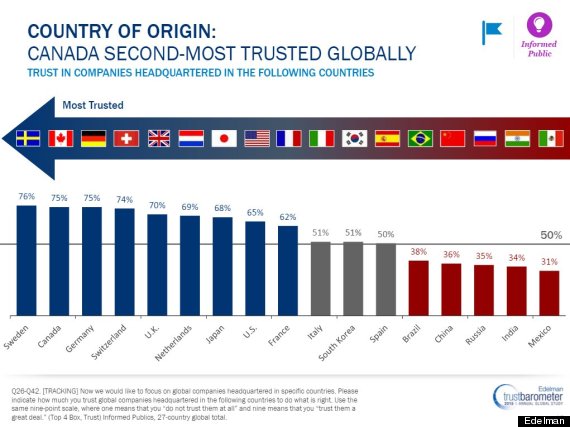
Canadian citizens are, for the most part, highly respected around the world. In fact, it is a matter of national pride that a Canadian can travel just about anywhere in the world, and as long as he or she displays a Canadian flag, open doors and smiles will be plentiful. However, an article in The Huffinton Post from the 9th of February 2015 entitled Canadian Businesses 2nd-Most Trusted In The World: Survey drew attention to the Ethical Debt balance sheet among Canadian companies. (Though they didn't call it that.)The story points out that "Canada saw the largest drop in trust in business of any of the 27 countries surveyed." What this tells me is that Canadian companies are trading internationally on the reputation of our citizens. The rest of the world trusts Canadian businesses almost implicitly, but the people who know us best (those within our borders) don't trust us like they used to.
This is a wake-up call to all businesses. Correct your Ethical Debt before you have no reputation left upon which to trade.
WR
Subscribe to:
Posts (Atom)